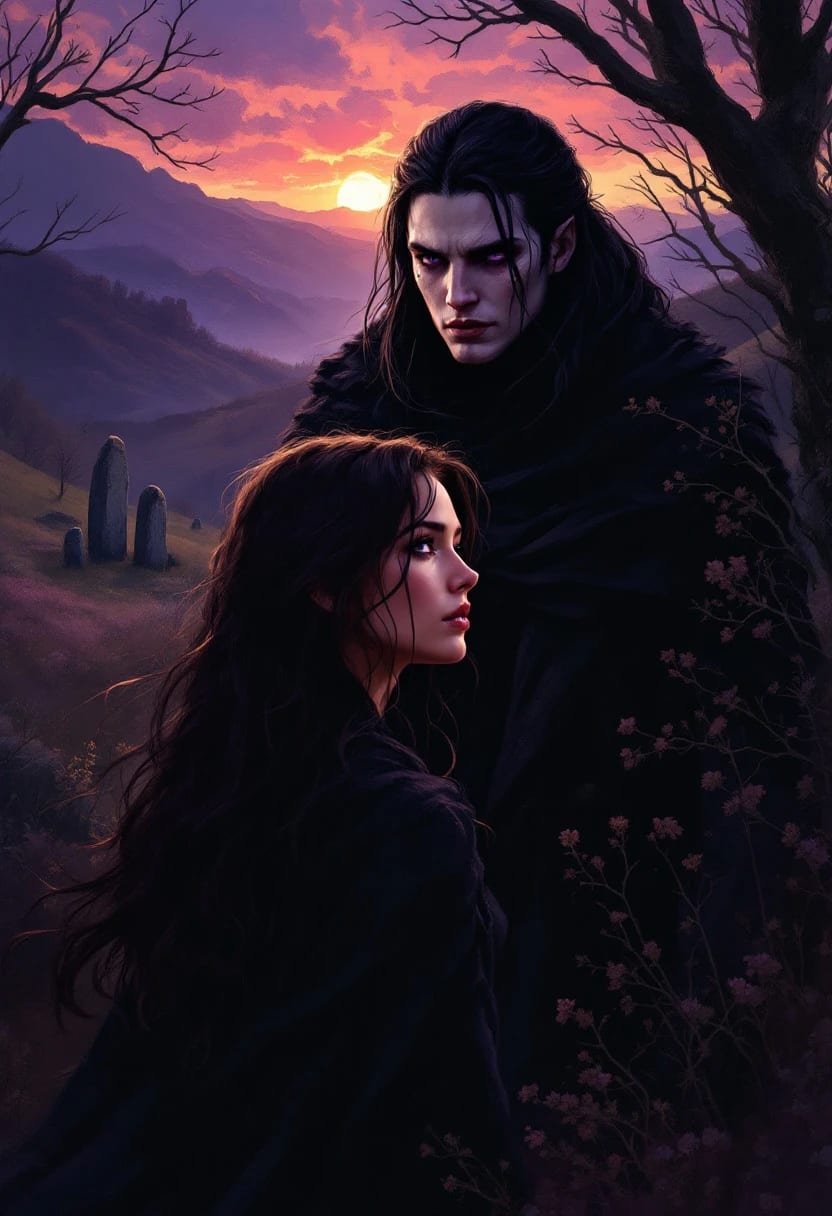
Dark fae romantasy · enemies to lovers · the bargain · morally grey · slow burn, closed door
You bargained with the lord of the Dusk Court for your sister's life. His price: a year and a day at his side.
Free to read. Then your own book, from $14.99 a month. Created with AI for one reader. Adults only.
Chapter 1 · free · 7 min · no sign-up
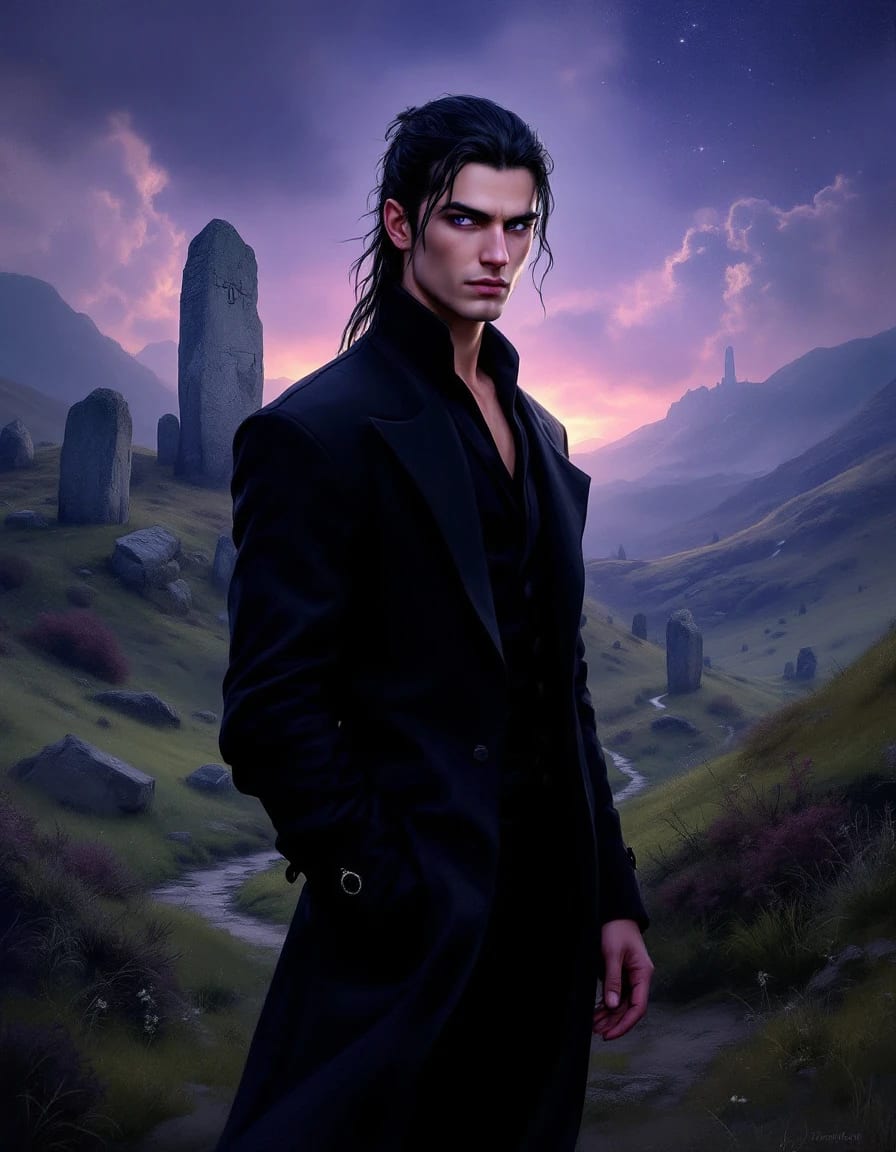
Him
Lord Emrys Vane, who looks thirty and is older than the treaty
Feared and morally grey. Gentle only with you.
“
‘You may hate me for a year and a day,’ he said. ‘I ask only that you do it at my table.’
enemies to lovers
the bargain
morally grey
only gentle with her
who did this to you
slow burn
Read it as
Optional. He will say it in the chapter.
Chapter 1
The Girl With No Shadow
❦
Ellery saw it before she understood it.
She had been standing in the cottage door for an hour with the lantern held high, watching the hill path for a small figure and a strayed ewe. Every seventh autumn Lantry shut its doors early on tithe night, and every seventh autumn somebody's ewe wandered anyway. When Posy finally came down out of the dusk with wool on her sleeves and no ewe at all, Ellery raised the light to call her a fool.
The light fell full across her sister. It lit her face, her shoulders, the muddy hem of her skirt, the flat stones of the path. Behind her it lit nothing but more stones. No dark shape stretched back up the hill at her heels. The path lay clean and bright, as if no one stood on it at all.
"Ellery?" Posy said. "I'm cold."
By morning her hands were cold. Ellery chafed them, held them to the stove, tucked them under her own arms until her ribs ached. By the second day the cold had reached Posy's face, and her lips went the gray of old snow. By the third morning she could barely lift her head from the pillow, and when she smiled it seemed to cost her something.
Ellery kept looking at the floor. The candle on the stool threw her own shadow huge across the wall and the quilt, and beside the bed, where Posy's should have lain, there was only bare scrubbed pine. She caught herself sweeping that spot twice in one afternoon, as if something had been spilled there. She had never hated a floor before.
The elders came on the third afternoon, three of them with their hats in their hands, ducking under the iron horseshoe over the kitchen door. Tom Harrow did the talking. He always did.
"It's the price of the treaty," he said. "It's been paid before. My own cousin paid it, the autumn I turned nine. She didn't suffer at the end. It's like going to sleep."
"She's not going to sleep."
"Ellery." He said it gently, which was worse. "Say your goodbyes while she can still hear them."
Ellery said nothing. Tom followed her eyes to the window, to the long brown shoulder of the hill and the nine gray stones on top of it, and his face changed.
"Don't," he said. "I know that look. Nobody who goes up to the Crowns comes back the same. If they come back at all."
"Then I'll come back different," Ellery said, and held the door for them until they went.
Her grandmother's knife was in the dresser drawer, under the good tablecloth. It had a black iron blade, pitted with age, and a handle wrapped in waxed twine. Ellery had never used it for anything but cutting bread. She put it in her belt, kissed Posy's cold forehead, and walked out while the chapel bell was ringing sunset.
The hill was steeper than she remembered. The bell was still going when she reached the top, thin and far away, and the Crowns stood around her taller than men, gray and lichened and patient. She walked between the two nearest.
The bell stopped. The wind stopped.
The sky above her was violet, deep and luminous, the exact color of the moment after the sun goes under, and it stayed that way. Below the hill lay black water, flat as glass, and along its shore an orchard of trees with silver leaves. The leaves were moving, turning and whispering against each other, and there was no wind at all.
He was waiting at the orchard's edge.
She knew him at once, though no one in Lantry had ever described him to her. He was tall and spare, dressed in black and pewter, his black hair tied back from a pale, severe face. He was standing quite still, and when he stepped toward her he made no sound on the grass. His shadow followed a beat later, as if it had needed a moment to decide.
"Ellery," he said. "You have come about Posy."
His voice was soft and very clear, the kind of voice that never needed to be raised. Ellery drew the knife and held it out between them. Her hand was not as steady as she wanted.
"You know her name."
"I know the name of every shadow I hold. Hers is the newest." He considered the knife without alarm. "I am Emrys Vane. The shadow is mine, to keep or to give, and I suspect you have come to tell me which."
He stopped just beyond the reach of the blade, exactly, as if he had measured it. He was not a large man the way the shearers in Lantry were large, but he seemed to take up more of the twilight than his body did. Ellery was aware of the space between them the way she would have been aware of a drop at her feet.
"You're a murderer," she said.
He did not flinch. His eyes were the violet of the sky behind him, and they did not leave her face.
"I have been called so before," he said. "By people with less cause than you. And by some with more."
"Give her back."
"Here, we do not give. We bargain." He tilted his head a fraction. "Ask me for one."
She hated him for making her say it. She said it anyway. "I want a bargain."
"Then hear my price. A year and a day, at my side."
❦
Lord Emrys Vane
"Take me instead," she said quickly. "My shadow for hers."
"No."
"Lantry's wool, then. A whole year's clip. Every fleece in the valley."
"I have no use for wool."
"A season. One season, and you can have whatever you want of it."
He waited until she had finished. The silver leaves whispered. He had not moved, and yet she had the strange impression that he had come no nearer only because he had decided not to.
"I have named my price," he said.
Posy's lips, gray as old snow. The bare boards beside the bed.
"Fine," Ellery said. "Yes."
He held out a cup she had not seen him take from anywhere, plain dark silver, filled with something that caught the violet light. "Speak your terms aloud. Then I will speak mine."
Her throat was dry. "My sister Posy's shadow, given back whole, and her life with it."
"And for it, a year and a day of you," he said, "at my side, in my Court, from this hour."
She took the cup in her free hand. His fingers closed over hers on the stem.
His skin was cold. She had expected that. She had not expected how steady his hand would be, or how completely it would cover hers, or how close she would have to stand to drink. Close enough to smell him, cold air and something green and bitter, like crushed leaves. Close enough that her knife hand had dropped without her noticing, and the iron hung useless at her side. She drank. He drank after her, his hand still over hers, and he did not look away, so she would not either. His skin was cold and his attention was not. It lay on her like the heat from an open oven door.
Then he let go, and stepped back to exactly where he had been.
"It is done," he said. "Look."
From inside his coat he drew a round of black glass no bigger than her palm and held it where she could see. In its depths was a room she knew. The candle on the stool. The quilt. The bare scrubbed boards.
A darkness slid across those boards like spilled ink running backward. It crept up the leg of the bed, over the quilt, and was gone. Posy opened her eyes. She pushed herself up on her elbows, then sat, color flooding back into her face, and turned toward the empty doorway. Her lips shaped a word Ellery knew.
Ellery?
Something cracked open in her chest. Before she could find out whether it was grief or relief or rage, the glass went dark.
"Come," Emrys said. "The Court is waiting, and it does not wait gracefully."
He did not take her arm. He simply walked, and she followed, because the alternative was standing alone in that whispering orchard. The ground sloped away and then there were steps under her feet, gray stone worn smooth, and doors of glass taller than the chapel, and beyond them a hall.
It was full of candlelight. Thousands of candles, on iron-free brackets of silver and glass, their flames standing straight up in the still air. There was music, something with strings in it that pulled at her like a hand on her sleeve. There were people, a great many people, in silk and feathers and colors she had no names for.
The music stopped mid-phrase.
Every face turned toward her. They were beautiful, all of them, and all of them were slightly wrong: features a shade too even, eyes too bright, smiles that arrived a heartbeat after the thought behind them. They looked at her the way the shearers looked at a tray carried in from the kitchen. With interest. With appetite.
Emrys walked through them as if they were furniture. The crowd parted without seeming to move. Ellery kept her chin up and her grandmother's knife in her belt and followed him the length of the hall to a high table on a dais of gray stone, where a single chair stood empty at the right hand of the largest one.
He drew it out and stood holding it, and turned his head to look at her.
"My guest," he said, not loudly. The whole hall heard it.
Nobody moved. Nobody breathed, or if they did, they had stopped needing to. Hundreds of bright, wrong eyes waited on her, and the man beside the chair waited too, very still, his shadow pooled a beat behind him on the stone.
She had been in the Dusk Court less than an hour. She had a year and a day ahead of her, among people who would want to know what a mortal guest was for.
How was she going to take her first step?
❦
The free chapter ends here
The whole Court is waiting. What do you do?
From this moment the story is yours: your name, your choices, a chapter written for you.
I am 18 or older
How it works
Your book, one choice at a time
1
Choose him.
2
Decide what happens.
3
Open a new chapter every night.
The plans
Your own book, from $14.99 a month
Every plan is billed monthly. The chapter count is always shown, and you can cancel online at any time.
$14.99
a month
10 chapters a month
Any day you like, at most one a day. Unused chapters do not carry over.
Your own cover
No talks between chapters
Renews monthly until you cancel
Cancel online in two taps
$29.99
a month
30 chapters a month
One a day, opening in the evening. Up to three unused days are kept.
Your own cover
Talk with him between chapters: 12 lines each time
Renews monthly until you cancel
Cancel online in two taps
$44.99
a month
30 chapters a month
One a day, opening in the evening. Up to three unused days are kept.
Your own cover
Talk with him between chapters: up to 100 lines each time
Renews monthly until you cancel
Cancel online in two taps
$99.99
a month
30 chapters a month
One a day, opening in the evening. Up to three unused days are kept.
Your own cover
Talk with him between chapters: up to 100 lines each time
Shorts about your story: coming soon
Renews monthly until you cancel
Cancel online in two taps
Heat and care · How it is made
Heat and care
Slow burn, closed door: anything beyond a kiss happens off the page. He never forces you, and your no always holds.
How it is made
Every story here is created with AI for one reader, guided by her choices. It is never published and never sold as a book. Your story is private.
Questions
Before you begin
Yes. Every story here is created with AI, chapter by chapter, from your choices. There are no human authors, and we never pretend otherwise.
Slow burn and closed door. There is longing, tension and kissing on the page; anything beyond a kiss happens off it. You choose how dark the story is: sweet, intense or dark.
The opening chapter of each story is free to read. Your own book comes with a plan: 10 chapters a month on the $14.99 plan, 30 chapters a month on the others. The count is always shown.
Online, in two taps, from your Account page. Your plan renews monthly until you cancel. Your book stays yours to read.
Only you. Your book is written for one reader, is never published and never sold as a book.
Other stories
Or begin another story